ในบทความนี้
In this post
หกโมงเช้าเศษ หน้าห้องเจาะเลือดของโรงพยาบาลรัฐแห่งหนึ่ง คิวหมายเลข 38 เป็นของป้าเสื้อลายดอกกับลุงเสื้อเชิ้ตสีเทา ลุงถือถุงซิปล็อกใส่ยา บัตรนัดสามใบ และกระติกน้ำใบเล็ก ป้าถือบัตรคิว สองคนไม่ได้คุยกัน ไม่ได้จับมือกัน แต่พอเสียงพยาบาลขานเลขใกล้เข้ามา ลุงลุกไปยืนข้างประตูก่อนป้าจะทันขยับตัว ป้าถอดแหวนหย่อนใส่กระเป๋าเสื้อของลุงโดยไม่ต้องเอ่ยขอ แล้วลุงก็ช่วยพับแขนเสื้อข้างซ้ายให้ — ข้างที่เส้นเลือดหายาก เขารู้ก่อนที่พยาบาลจะทันถาม
สิบนาทีนั้นไม่มีคำว่ารักสักคำ ไม่มีดอกไม้ ไม่มีเพลงประกอบ มีแต่การเคลื่อนไหวเล็ก ๆ ที่เข้าขากันจนเกือบมองไม่เห็น เหมือนช่างไม้สองคนที่ทำงานด้วยกันมานานจนไม่ต้องพูดว่าใครจับปลายไหน ผมนั่งอยู่สองแถวถัดไป และคำถามหนึ่งตามผมกลับบ้านมาด้วย: สิ่งที่ผมเพิ่งเห็นเมื่อกี้ เป็น "ความรู้สึก" หรือเป็น "ฝีมือ"
เราถูกสอนให้รู้จักรักในภาษาของอาการ — ตกหลุม ใจเต้น หวั่นไหว เคมีตรงกัน — ล้วนเป็นสิ่งที่ "เกิดขึ้นกับเรา" ไม่ใช่สิ่งที่เราลงมือทำ ตอนที่แล้วเราคุยเรื่องมิตรภาพ — อริสโตเติลบอกว่าต่อให้มีทุกอย่างครบ ก็ไม่มีใครเลือกมีชีวิตอยู่โดยไม่มีมิตร — ตอนนี้เราขยับเข้ามาอีกหนึ่งช่วงแขน สู่คนที่เราเลือกจะตื่นมาเจอทุกวัน และคำถามของบทความนี้ก็คือคำถามเดียวกับที่เกิดหน้าห้องเจาะเลือดเช้านั้น: ถ้ารักไม่ใช่อาการ แต่เป็นคำกริยา เราจะผันมันอย่างไรในสัปดาห์ธรรมดา ๆ ของคนธรรมดา
กวีหนึ่งคน นักจิตวิเคราะห์หนึ่งคน และนักคิดอีกสองคนที่ส่งนิยามเดียวกันต่อมือกันข้ามเวลายี่สิบสองปี จะช่วยกันตอบ — และมีคู่สามีภรรยาในโรงเพิงหลังคารั่วแห่งหนึ่งในปารีส คอยยืนยันด้วยชีวิตจริงทั้งชีวิต
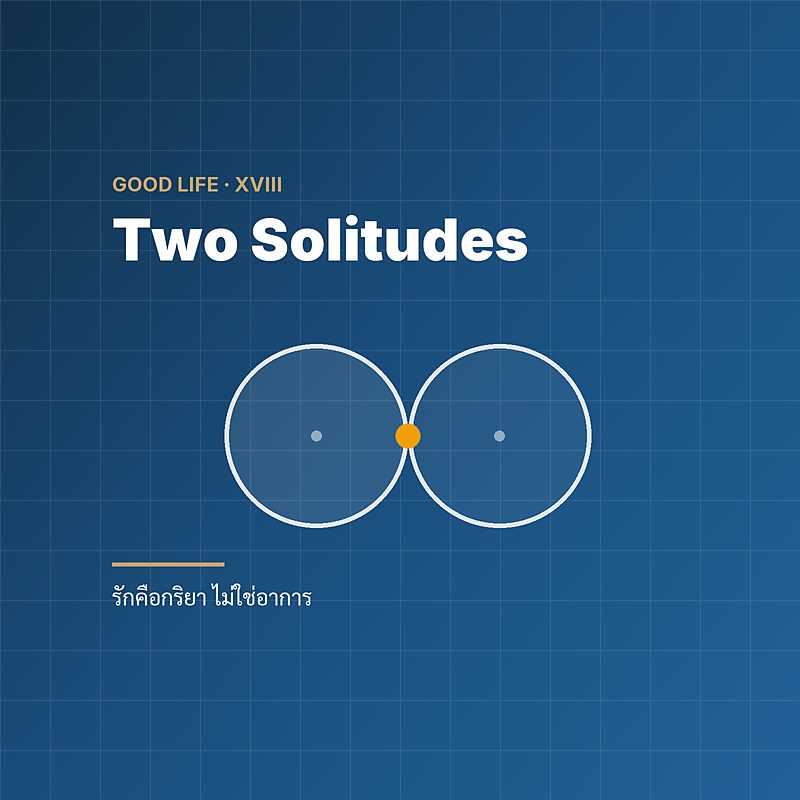
เดียวดายสองดวงที่ทักทายกัน
"ความรักคือสิ่งนี้: ความเดียวดายสองดวง ที่ปกป้องกัน กั้นเขตให้กัน และทักทายกันและกัน"
ไรเนอร์ มาเรีย ริลเคอ, Briefe an einen jungen Dichter, จดหมายฉบับที่ 7 (โรม, 14 พฤษภาคม 1904) — ผู้เขียนแปล
…der Liebe, die darin besteht, daß zwei Einsamkeiten einander schützen, grenzen und grüßen.
ปี 1902 นักเรียนนายร้อยชาวออสเตรียอายุสิบเก้าชื่อ ฟรันซ์ คซาเวอร์ คัปปุส ส่งบทกวีของตัวเองไปขอความเห็นจากกวีที่เขาชื่นชม สิ่งที่ได้กลับมาคือจดหมายสิบฉบับในเวลาห้าปีเศษ ซึ่งภายหลังคัปปุสรวบรวมตีพิมพ์เป็นหนังสือเล่มเล็กชื่อ จดหมายถึงกวีหนุ่ม ฉบับที่เจ็ด — ฉบับที่ประโยคข้างบนอาศัยอยู่ — เขียนจากโรมกลางเดือนพฤษภาคม 1904 และควรบันทึกไว้ด้วยว่าตอนนั้นริลเคอเองอายุเพิ่งยี่สิบแปด ไม่ใช่ปราชญ์เฒ่าบนยอดเขา แต่เป็นชายหนุ่มอีกคนที่กำลังคลำทางเรื่องเดียวกันนี้อยู่เหมือนกัน
สิ่งที่จดหมายพูดจริง ๆ ยาวและหนักมือกว่าประโยคที่ถูกตัดไปแปะการ์ดอวยพรมาก ริลเคอบอกคัปปุสว่าการรักกันระหว่างมนุษย์กับมนุษย์นั้น "อาจเป็นงานที่ยากที่สุดที่ถูกมอบหมายแก่เรา เป็นบทพิสูจน์และการทดสอบขั้นสุดท้าย เป็นงานที่งานอื่นทั้งหมดเป็นเพียงการเตรียมมือ" และเพราะมันยากขนาดนั้น คนหนุ่มสาวซึ่งเป็นมือใหม่ในทุกเรื่อง "จึงยังรักไม่เป็น — พวกเขาต้องเรียนมัน" เขาเตือนว่าเมื่อความรักมาถึง คนหนุ่มสาวมักเหวี่ยงตัวเองเข้าใส่กัน ละลายรวมเป็นก้อนเดียวจนไม่เหลือใครสักคน แล้วเรียกความพร่าเลือนนั้นว่าความเป็นหนึ่งเดียว ทางที่ริลเคอเสนอกลับหัวกลับหางกับสัญชาตญาณ: จงใช้ความรักเป็นโอกาสอันสูงส่งที่จะ "สุกงอม กลายเป็นบางสิ่งในตัวเอง กลายเป็นโลกทั้งใบในตัวเอง — เพื่อเห็นแก่อีกคนหนึ่ง"
ประโยคเดียวดายสองดวงจึงไม่ใช่คำหวาน มันมาถึงตอนท้ายของข้อถกยาวในฐานะภาพของรักที่โตเต็มวัยแล้ว และโปรดสังเกตคำตรงกลาง: ปกป้อง — กั้นเขต — ทักทาย ฉบับที่แพร่หลายในอินเทอร์เน็ตจำนวนมากตัดคำที่สองทิ้งไป เหลือเพียง "สองความเหงาที่พบกัน ปกป้องกัน และทักทายกัน" ซึ่งฟังหวานขึ้น แต่เสียใจความสำคัญที่สุดไป เพราะ "กั้นเขต" (grenzen) คือหัวใจของประโยค การทักทายเกิดขึ้นได้ก็เพราะยังมีรั้ว ถ้ารั้วพังลง สิ่งที่เหลือไม่ใช่การทักทาย แต่เป็นการกลืนกันและกัน
สิ่งที่ประโยคนี้ขอจากเรา: อย่ามอบหมายให้อีกฝ่ายเป็นคำตอบของความว่างเปล่าในตัวเรา จงเป็นบ้านทั้งหลังของตัวเองให้ได้ก่อน แล้วค่อยเปิดหน้าต่างให้แก่กัน — และเพื่อความเป็นธรรมต่อคุณผู้อ่าน ต้องหมายเหตุด้วยว่านี่คือจดหมายแนะนำชายหนุ่มโสดคนหนึ่ง ไม่ใช่ผลการทดลองที่ผ่านการพิสูจน์ ริลเคอให้ "ภาพ" ที่งดงามพอจะถือไว้ในมือ ส่วนหลักฐานว่าภาพนี้ตรงกับชีวิตจริงแค่ไหน เราจะไปตามหากันต่อข้างล่าง
ยืนอยู่ในรัก ไม่ใช่ตกหลุม
"ความรักคือกิจกรรม ไม่ใช่อาการที่เกิดขึ้นกับเรา มันคือการ 'ยืนอยู่ใน' ไม่ใช่การ 'ตกหลุม'"
อีริช ฟรอมม์, The Art of Loving (Harper & Row, 1956), บทที่ 2 — ผู้เขียนแปล
Love is an activity, not a passive affect; it is a "standing in," not a "falling for."
ห้าสิบสองปีหลังจดหมายของริลเคอ นักจิตวิเคราะห์ผู้ลี้ภัยนาซีชื่อ อีริช ฟรอมม์ เขียนหนังสือเล่มบางชื่อ The Art of Loving (1956) และเปิดเล่มด้วยคำถามที่ฟังเหมือนกวนแต่เอาจริง: "รักเป็นศิลปะหรือ? ถ้าใช่ มันก็ต้องการความรู้และความพยายาม" คนส่วนใหญ่ ฟรอมม์ว่า เชื่อลึก ๆ ว่ารักเป็นเรื่องของดวงและโชค ไม่มีอะไรต้องเรียน มีแต่ต้องรอ
เขาชำแหละความเชื่อนั้นออกเป็นความเข้าใจผิดสามข้อ ข้อแรก เราหมกมุ่นกับการ "ถูกรัก" มากกว่าการ "รักเป็น" — เราลงทุนมหาศาลกับความน่ารัก เสน่ห์ รูปร่าง ความสำเร็จ ราวกับโจทย์มีอยู่ข้อเดียวคือทำอย่างไรให้มีคนมารัก ไม่ใช่ทำอย่างไรให้เรารักใครได้จริง ข้อสอง เราคิดว่าปัญหาอยู่ที่ "วัตถุ" ไม่ใช่ "ความสามารถ" — ยังไม่เจอคนที่ใช่เท่านั้นเอง พอเจอแล้วทุกอย่างจะไหลลื่นเอง ซึ่งก็เหมือนคนอยากวาดรูปเป็นที่ไม่เคยหัดจับพู่กัน เอาแต่ตระเวนหาแบบที่สวยพอจะทำให้ตัวเองวาดเก่ง ข้อสาม — ข้อที่เจ็บที่สุด — เราสับสนระหว่างประสบการณ์ "ตก" หลุมรักครั้งแรกอันเข้มข้นหวือหวา กับสถานะ "ยืน" อยู่ในรักอันยาวนาน แล้วพอความเข้มข้นจางลงตามธรรมชาติ ก็รีบสรุปว่ารักหมดแล้ว ทั้งที่มันเพิ่งจะเริ่ม
ประโยคที่เรายกมาอยู่ในบทที่สอง ตรงที่ฟรอมม์อธิบายว่าธรรมชาติเชิงรุกของรักสรุปได้สั้นที่สุดว่า รักคือการให้เป็นหลัก ไม่ใช่การรับ และการให้ที่ว่าประกอบด้วยธาตุสี่อย่างที่ปรากฏร่วมกันในรักทุกรูปแบบ: ความใส่ใจ ความรับผิดชอบ ความเคารพ และความรู้ — โปรดสังเกตว่าทั้งสี่คำล้วนเป็นคำกริยาแฝงตัวมาในร่างคำนาม ไม่มีสักคำที่เป็นอาการซึ่งเกิดเองได้โดยเราไม่ต้องทำอะไร
คนมักอ่านฟรอมม์ผิดไปว่าเขาดูแคลนความหวานของช่วงตกหลุมรัก เปล่าเลย — เขาไม่ได้ห้ามใครตก เขาเพียงชี้ว่าหลักฐานของรักไม่ได้อยู่ตรงนั้น แรงโน้มถ่วงพาเราตกได้โดยไม่ต้องฝึกฝนอะไรเลยสักนิด แต่ไม่มีแรงโน้มถ่วงชนิดไหนในจักรวาลช่วยให้เรายืน การยืนต้องใช้กล้ามเนื้อ และกล้ามเนื้อมีทางเดียวที่จะได้มา: ซ้อม
รักคือสิ่งที่รักกระทำ
"รักคือสิ่งที่รักกระทำ รักคือการกระทำของเจตจำนง — คือทั้งความตั้งใจและการลงมือทำ"
เอ็ม. สก็อตต์ เพ็ก, The Road Less Traveled (1978) — ประโยคที่ เบลล์ ฮุกส์ ยกมาเป็นแกนของ All About Love (2000) — ผู้เขียนแปล
Love is as love does. Love is an act of will — namely, both an intention and an action.
ประโยคนี้ถูกแชร์นับล้านครั้งใต้ชื่อ เบลล์ ฮุกส์ นักคิดเฟมินิสต์ผู้เขียน All About Love — และเรื่องจริงซับซ้อนกว่านั้นนิดเดียว แต่ดีกว่านั้นมาก ฮุกส์เปิดบทแรกของหนังสือด้วยการสารภาพว่าเธอใช้เวลาหลายปีตามหานิยามของรักที่ใช้งานได้จริง และ "โล่งใจอย่างยิ่ง" เมื่อพบมันในหนังสือของจิตแพทย์ เอ็ม. สก็อตต์ เพ็ก เรื่อง The Road Less Traveled ซึ่งตีพิมพ์ก่อนหน้านั้นยี่สิบสองปี นิยามที่ว่า: รักคือ "เจตจำนงที่จะขยายตัวตนของเราออกไป เพื่อหล่อเลี้ยงการเติบโตทางจิตวิญญาณของตัวเองหรือของผู้อื่น" แล้วเพ็กก็ขยายความต่อด้วยประโยคที่กลายเป็นตำนาน: รักคือสิ่งที่รักกระทำ
เครดิตจึงเป็นของสองคน เพ็กเป็นคนตีดาบ ฮุกส์เป็นคนหยิบดาบเล่มนั้นไปใช้ในสนามที่กว้างกว่าห้องบำบัด — ครอบครัว ชุมชน และการเมืองของความรัก — และเธอให้เครดิตเจ้าของนิยามอย่างเปิดเผยตั้งแต่หน้าแรก ๆ ของหนังสือ ความซื่อตรงเล็ก ๆ นี้เองก็เป็นตัวอย่างของสิ่งที่เธอเขียนถึงพอดี: การมองเห็นและยอมรับผู้อื่นตามจริง เป็นกริยาหนึ่งของรักเหมือนกัน
สิ่งที่ฮุกส์เติมเข้าไปแล้วทำให้นิยามนี้คมขึ้นมากคือผลลัพธ์เชิงตรรกะของมัน: ถ้ารักคือกริยา ไม่ใช่ความรู้สึก นิยามนี้ก็วาดเส้นแบ่งที่ชัดเจนอย่างที่ความรู้สึกไม่มีวันวาดได้ — "รักกับการทำร้ายอยู่ร่วมกันไม่ได้" บ้านที่มีการทำร้าย ด้วยมือหรือด้วยคำพูด จึงไม่ใช่บ้านที่ "รักกันแต่แสดงออกไม่เป็น" มันคือบ้านที่กริยาของรักไม่ได้ถูกกระทำ ส่วนเครื่องปรุงที่ฮุกส์ไล่รายการไว้ อ่านแล้วเหมือนสูตรอาหารมากกว่าบทกวี: ความใส่ใจ ความเอ็นดู การมองเห็นกัน ความเคารพ ความผูกมัดตน ความไว้ใจ และการสื่อสารที่ตรงไปตรงมาและเปิดเผย
ผมคิดว่าคุณูปการที่ใหญ่ที่สุดของนิยามสายเพ็ก–ฮุกส์ไม่ใช่ความไพเราะ แต่คือความตรวจสอบได้ ความรู้สึกตรวจสอบไม่ได้ — มันขึ้นลงตามน้ำตาลในเลือด ตามคุณภาพการนอน ตามฝนตกรถติด — แต่การกระทำทิ้งร่องรอยเสมอ: ปฏิทินบอกว่าเราให้เวลาใครไปเท่าไร จานที่ถูกล้างมีคนล้างจริง คำขอโทษเกิดขึ้นจริงหรือไม่เกิด ผมจึงเชื่อคำถาม "สัปดาห์นี้เราได้รักกันหรือยัง" มากกว่า "เรายังรักกันอยู่ไหม" — ข้อแรกตอบได้ด้วยหลักฐาน ข้อหลังตอบได้ด้วยอารมณ์ของวันนั้น
ข้อควรระวังมีข้อเดียว: อย่าใช้ประโยคนี้เป็นไม้เรียวไว้ตีอีกฝ่ายว่า "ถ้ารักจริงต้องทำนั่นทำนี่" นิยามนี้ถูกออกแบบมาให้เป็นกระจกส่องตัวเองก่อน — สิ่งที่ฉันทำไปสัปดาห์นี้ นับเป็นกริยาของรักได้กี่ครั้ง — แล้วจึงค่อยเป็นไม้บรรทัดวัดความสัมพันธ์ทีหลัง
โรงเพิงหลังคารั่วกับความฝันสามข้อ
ปารีส 1894 นักศึกษาฟิสิกส์หญิงชาวโปแลนด์ชื่อ มาเรีย สกวอดอฟสกา พบนักฟิสิกส์หนุ่มขี้เงียบชื่อ ปีแยร์ กูรี ฤดูร้อนปีนั้นเธอกลับบ้านเกิด และเขาเขียนจดหมายตามไป ในจดหมายที่มารีเก็บรักษาไว้และตีพิมพ์ภายหลังในหนังสือรำลึกถึงสามี มีประโยคที่อาจเป็นคำเกี้ยวที่ประหลาดที่สุดในประวัติศาสตร์วิทยาศาสตร์: "คงจะเป็นเรื่องงดงาม — ซึ่งผมแทบไม่กล้าเชื่อว่าจะเป็นจริง — หากเราได้ใช้ชีวิตผ่านไปด้วยกัน โดยถูกสะกดอยู่ในความฝันของเรา: ความฝันของคุณเพื่อบ้านเกิดของคุณ ความฝันของเราเพื่อมนุษยชาติ ความฝันของเราเพื่อวิทยาศาสตร์" โปรดสังเกตลำดับ เขาวางความฝันของเธอ — โปแลนด์ ซึ่งอาจพรากเธอไปจากเขาตลอดกาล — ไว้เป็นข้อแรก ก่อนความฝันร่วมอีกสองข้อ นี่คือชายที่เกี้ยวผู้หญิงด้วยการเคารพเขตแดนของเธอ ริลเคอยังไม่ทันเขียนจดหมายฉบับที่เจ็ด ปีแยร์ก็ลงมือทำให้ดูก่อนแล้วสิบปี
ทั้งคู่แต่งงานกันในเดือนกรกฎาคม 1895 แบบที่มารีเรียกว่าพิธีที่เรียบง่ายที่สุดเท่าที่จะเป็นได้ — จดทะเบียนแพ่ง ไม่มีพิธีศาสนา และตามบันทึกในคำนำของหนังสือฉบับอเมริกัน เงินของขวัญที่ตั้งใจให้เป็นค่าชุดเจ้าสาวถูกนำไปซื้อจักรยานสองคัน ไว้ปั่นเที่ยวชนบทฝรั่งเศสด้วยกัน ชีวิตคู่ของพวกเขา มารีสรุปด้วยประโยคเรียบ ๆ ที่อ่านแล้วต้องหยุด: "เราใช้ชีวิตเป็นหนึ่งเดียวอย่างยิ่ง สนใจในสิ่งเดียวกัน — การทดลองในห้องปฏิบัติการ การเตรียมการสอนและการสอบ" และอีกประโยค: "ตลอดสิบเอ็ดปี เราแทบไม่เคยแยกจากกันเลย จดหมายระหว่างเราในช่วงเวลานั้นจึงเหลืออยู่เพียงไม่กี่บรรทัด" คู่รักที่จดหมายรักน้อยที่สุด อาจเป็นคู่ที่ไม่เคยต้องอยู่ไกลกันพอจะเขียน
ภาพจำของโลกคือเหรียญรางวัลและชื่อธาตุในตารางธาตุ แต่ฉากจริงของรักนี้คือโรงเพิงไม้หลังโรงเรียนฟิสิกส์และเคมีอุตสาหกรรมแห่งกรุงปารีส ที่ซึ่งทั้งคู่ใช้เวลาหลายปีสกัดธาตุใหม่ออกจากกองแร่มหึมา มารีบรรยายที่ทำงานแห่งนั้นไว้เอง: เพิงไม้พื้นยางมะตอย หลังคากระจกที่กันฝนไม่อยู่ ไม่มีสิ่งอำนวยความสะดวกใดภายใน ร้อนอบอ้าวหน้าร้อน เยือกเย็นหน้าหนาว — แล้วเธอก็เขียนประโยคที่ควรจารึก: "เราอาศัยอยู่ในภวังค์อันสมบูรณ์ ราวกับอยู่ในความฝัน" บางค่ำหลังอาหาร สองคนเดินกลับไปที่เพิงเพื่อยืนดูผลงานของตัวเอง หลอดแก้วบรรจุสารเรืองแสงวางเรียงบนโต๊ะและไม้กระดาน "ประกายเรือง ๆ ที่เหมือนลอยค้างอยู่ในความมืดเหล่านั้น ปลุกเร้าเราด้วยความตื่นใจและมนตร์เสน่ห์ครั้งใหม่อยู่เสมอ" นั่นคือการออกเดตของตระกูลกูรี: สองคนยืนเงียบ ๆ ในโรงเพิงหลังคารั่ว มองแสงที่ตัวเองขุดขึ้นมาจากก้อนหิน
และตรงนี้เองที่เรื่องนี้ตอบทั้งริลเคอ ฟรอมม์ และเพ็กพร้อมกันในฉากเดียว ปีแยร์มีงานของตัวเอง — การศึกษาผลึกที่เขารักและบุกเบิกมาก่อน — เมื่องานของมารีเริ่มเผยบางสิ่งที่ใหญ่กว่า เขาจึงพักการวิจัยของตัวเองไว้เพื่อข้ามมาสมทบกับงานของเธอ นี่ไม่ใช่การละลายตัวตนเข้าหากัน เขายังเป็นนักฟิสิกส์ของเขา เธอยังเป็นนักเคมีของเธอ สองความเดียวดายที่กั้นเขตกันอยู่ ทักทายกันทุกวันข้ามโต๊ะทดลอง และในวันที่อีกฝ่ายต้องการ ก็เลือกข้ามรั้วมาด้วยความสมัครใจ ไม่ใช่เพราะรั้วพัง
เช้าวันที่ 19 เมษายน 1906 ฝนตก ปีแยร์เดินข้ามถนน Rue Dauphine และถูกรถม้าบรรทุกทับ เสียชีวิตในทันที ไม่ถึงหนึ่งเดือนถัดมา คณะฟิสิกส์แห่งมหาวิทยาลัยปารีสลงมติมอบตำแหน่งศาสตราจารย์ของเขาให้แก่มารี — ผู้หญิงคนแรกที่ได้เป็นศาสตราจารย์ของมหาวิทยาลัยแห่งนั้น เธอเขียนถึงการตัดสินใจครั้งนั้นสั้น ๆ ว่า "ฉันรับมรดกอันหนักอึ้งนี้ไว้ ด้วยความหวังว่าสักวันหนึ่งจะสร้างห้องปฏิบัติการที่คู่ควรกับความทรงจำของเขาขึ้นมาให้ได้" รักคือสิ่งที่รักกระทำ — และเมื่อคนหนึ่งจากไป กริยายังผันต่อได้: เธอสอนวิชาของเขาต่อ สานความฝันข้อที่สามต่อจนสุดทาง ประโยคที่เธอใช้สรุปสิบเอ็ดปีนั้นไม่มีคำว่ารักอยู่เลยสักคำ แต่เต็มไปด้วยธาตุข้อที่สี่ของฟรอมม์ — ความรู้: "ในชีวิตร่วมกัน ฉันได้รู้จักเขาอย่างที่เขาหวังให้ฉันรู้จัก และได้หยั่งลึกเข้าไปในความคิดของเขามากขึ้นทุกวัน"
งานวิจัยพูดว่าอะไร — และไม่ได้พูดว่าอะไร
คราวนี้ถึงตาห้องทดลอง จอห์น ก็อตต์แมน กับ โรเบิร์ต เลเวนสัน ติดตามคู่แต่งงาน 73 คู่ระหว่างปี 1983–1987 โดยให้นั่งคุยเรื่องขัดแย้งจริง ๆ ต่อหน้ากล้อง แล้วแบ่งคู่ตามสมดุลของพฤติกรรมบวกต่อลบระหว่างการปะทะ[5] คู่ที่สมดุลเอียงข้างบวกชัดเจนพอใจในชีวิตคู่มากกว่า สุขภาพดีกว่า และมีแนวโน้มแตกหักน้อยกว่า ส่วนคู่ที่ไม่เป็นเช่นนั้นแสดงอารมณ์ลบมากกว่า ตั้งรับมากกว่า ดื้อดึงและถอนตัวจากบทสนทนามากกว่า จากงานตระกูลนี้ สถาบันของก็อตต์แมนสรุปออกมาเป็นตัวเลขที่โด่งดังที่สุดในวงการชีวิตคู่: ระหว่างความขัดแย้ง คู่ที่มั่นคงมีปฏิสัมพันธ์เชิงบวกราวห้าครั้งต่อเชิงลบหนึ่งครั้ง — อัตราส่วน 5:1 ที่ถูกเรียกขานว่า "สัดส่วนมหัศจรรย์"
แต่ต้องเล่าส่วนที่โปสเตอร์ไม่เล่าด้วย คำอวดอ้างที่ว่าก็อตต์แมน "ทำนายการหย่าได้แม่นกว่า 90%" ถูกตรวจสอบอย่างถึงรากโดย ริชาร์ด เฮย์แมน กับ เอมี สมิธ สเลป[6] ประเด็นคือ ตัวเลขความแม่นเหล่านั้นมาจากสมการที่สร้าง "ย้อนหลัง" บนข้อมูลซึ่งรู้ผลลัพธ์อยู่แล้ว และแทบไม่เคยถูกทดสอบซ้ำกับคู่ชุดใหม่ที่ยังไม่รู้ชะตากรรม เมื่อสองนักวิจัยลองทำการทดสอบซ้ำ (crossvalidation) กับข้อมูลจริง ความแม่นและค่าพยากรณ์ "ร่วงลงอย่างฮวบฮาบ" นักข่าว ลอรี อับราฮัม สรุปเป็นภาษาชาวบ้านไว้ว่า งานปี 1998 ที่โด่งดังใช้คู่แต่งงานใหม่เพียง 57 คู่ และเมื่อคำนวณฐานอัตราการหย่าจริงในประชากรเข้าไปด้วย คำทำนายแบบเดียวกันจะถูกไม่ถึงครึ่ง บทเรียนไม่ใช่ว่าก็อตต์แมนผิดทั้งหมด — ทิศทางใหญ่ของงานยืนได้มั่นคง: ความบวกเล็ก ๆ ที่สม่ำเสมอสำคัญกว่าความหวานเป็นพัก ๆ และการตั้งรับ ปิดกั้น ถอนตัว กัดกร่อนความสัมพันธ์จริง — แต่ตัวเลขเป๊ะ ๆ อย่าง 5:1 และวลี "ทำนายแม่น 94%" นั้น เป็นวิทยาศาสตร์อยู่ครึ่งเดียว อีกครึ่งเป็นการตลาด
อีกสายหนึ่งคือทฤษฎีความผูกพัน (attachment theory) ที่ จอห์น โบลบี้ และ แมรี เอนส์เวิร์ธ พัฒนาจากการเฝ้าดูทารกกับผู้เลี้ยงดู ซินดี ฮาซาน กับ ฟิลลิป เชเวอร์ ทดลองแปลกรอบนี้มาใช้กับรักโรแมนติกของผู้ใหญ่[7] และพบว่ารูปแบบสามอย่างในวัยทารก — มั่นคง หลีกหนี และกังวลสองจิตสองใจ — ปรากฏในผู้ใหญ่ด้วยสัดส่วนใกล้เคียงกัน และแต่ละแบบสัมพันธ์กับวิธีที่เรารัก หึงหวง ไว้ใจ และเลิกรา อย่างมีแบบแผนพอจะทำนายได้
แต่คำเตือนสำคัญกว่าตัวทฤษฎี: อย่าอ่านมันเป็นคำพิพากษา งานวิเคราะห์อภิมานที่รวบรวม 127 การศึกษา ข้อมูลกว่า 21,000 ราย พบว่าความคงตัวของรูปแบบความผูกพันจากวัยเด็กสู่วัยผู้ใหญ่อยู่เพียงระดับกลาง (r = .39) และเมื่อช่วงเวลาห่างกันเกิน 15 ปี แทบตรวจไม่พบความคงตัวอย่างมีนัยสำคัญเลย[8] พูดอีกแบบ: วัยเด็กเป็นจุดตั้งต้น ไม่ใช่คุก คนที่โตมาอย่างไม่มั่นคงสามารถสร้างความมั่นคงขึ้นใหม่ได้ในความสัมพันธ์ที่ดี — ซึ่งฟังดูเหมือนอะไรครับ? เหมือนการฝึกฝีมืออย่างที่ฟรอมม์ยืนยันไว้ไม่มีผิด
ลองสัปดาห์นี้
ถ้ารักคือกริยา สัปดาห์นี้ก็คือสนามซ้อม สองการทดลองข้างล่างออกแบบมาให้เล็กพอทำได้จริง และแปลกพอจะไม่กลายเป็นกิจวัตรกลวง ๆ
เจ็ดวัน เจ็ดกริยา (จันทร์–อาทิตย์) เลือกคนหนึ่งคน — คู่ชีวิต แฟน พ่อแม่ หรือเพื่อนสนิท — แล้วทำกริยาของรักวันละหนึ่งอย่างที่มีต้นทุนจริง (เวลา แรง หรือความสะดวกของเรา) โดยใช้รายการเครื่องปรุงของฮุกส์เป็นเมนู: วันหนึ่งคือความใส่ใจ (ฟังโดยวางมือถือคว่ำไว้ห้องอื่น) วันหนึ่งคือการมองเห็น (บอกสิ่งที่เขาทำแล้วเราสังเกตเห็นจริง ๆ) วันหนึ่งคือความไว้ใจ (มอบเรื่องที่เคยกุมไว้ให้เขาตัดสินใจ) กติกาสองข้อ: ห้ามประกาศว่ากำลังทำโครงการนี้อยู่ และห้ามทวงผลตอบแทนในทุกรูปแบบ จดหนึ่งบรรทัดต่อวันในโน้ตมือถือว่าทำอะไรไปและเกิดอะไรขึ้น
คืนวันอาทิตย์ อ่านโน้ตทั้งเจ็ดบรรทัด แล้วถามตัวเองข้อเดียว: สัปดาห์แบบนี้อีกห้าสิบสัปดาห์ จะกลายเป็นความสัมพันธ์หน้าตาแบบไหน
ของขวัญสองชั่วโมงเดียวดาย (ภายในวันพฤหัสฯ) เลือกวันหนึ่งก่อนสิ้นสัปดาห์ ยกเวลาสองชั่วโมงให้คนที่คุณรักเป็นของเขาคนเดียวโดยไม่มีเงื่อนไข: รับภาระของเขาไว้เอง — ลูก จานชาม ธุระที่ค้าง — แล้วบอกสั้น ๆ ว่า "ไปเถอะ เดี๋ยวจัดการเอง" ห้ามถามว่าจะไปไหน และเมื่อเขากลับมา ห้ามถามว่าไปทำอะไรมา นี่คือการซ้อมเฝ้ารั้วให้ความเดียวดายของคนที่เรารักตามแบบริลเคอ — และถ้าคุณอยู่คนเดียว ให้ทำสิ่งเดียวกันนี้กับเพื่อนสนิทหรือพ่อแม่ เพราะกริยาของรักไม่เคยผูกขาดอยู่กับคู่รักเท่านั้น
ถามตัวเองอีกครั้งวันอาทิตย์
กลับไปที่หน้าห้องเจาะเลือดกันอีกครั้ง ป้ากับลุงคู่นั้นคงไม่เคยอ่านริลเคอ ไม่รู้จักค่า r และไม่เคยนับว่าเช้านั้นเป็นปฏิสัมพันธ์บวกครั้งที่เท่าไรของสัปดาห์ แต่การพับแขนเสื้อข้างที่ถูกให้กันโดยไม่ต้องบอก ไม่ใช่ปาฏิหาริย์และไม่ใช่โชค มันคือหน้าตาของกริยาเล็ก ๆ ที่ถูกผันซ้ำทุกวันจนครบสี่สิบปี รักแบบที่เราอยากได้ตอนแก่ ไม่มีขายตอนแก่ มันผ่อนจ่ายเป็นรายวัน และงวดแรกครบกำหนดสัปดาห์นี้
ตอนถัดไปเราจะคุยกันเรื่องแขกที่มาเยือนทุกบ้าน ไม่เว้นแม้บ้านที่รักกันมากที่สุด — ความโกรธ และวิธีที่ปราชญ์ตะวันออกกับตะวันตกสอนให้ถือมันโดยไม่ให้มันลวกมือ: /blog/good-life-anger
อ้างอิง
ตรวจสอบทุกแหล่งเมื่อ 8 กันยายน 2026 · ป้ายสามแบบ: Source ตัวบทต้นทางที่คำคมปรากฏ · Study งานวิจัยที่อ้างในบทความ · Synthesis การสังเคราะห์หรือแหล่งที่ไม่ใช่งานวิจัย
- Source Rilke, R. M. Briefe an einen jungen Dichter, จดหมายฉบับที่ 7 (โรม, 14 พฤษภาคม 1904), รวมเล่มโดย Insel Verlag 1929. ต้นฉบับเยอรมัน: rilke.de · ฉบับแปลอังกฤษโดย A. S. Kline (2021): poetryintranslation.com — เข้าถึง 2026-09-08. รองรับ: ถ้อยคำ "zwei Einsamkeiten einander schützen, grenzen und grüßen" บริบทของจดหมาย ผู้รับ และวันที่
- Source Fromm, E. The Art of Loving. Harper & Row, 1956, บทที่ 2. สำเนาตัวบทเต็ม: archive.org — เข้าถึง 2026-09-08. รองรับ: ประโยค "standing in, not falling for" คำถามเปิดเล่ม ความเข้าใจผิดสามข้อ และธาตุสี่อย่างของรัก
- Source hooks, b. All About Love: New Visions. William Morrow, 2000, บทที่ 1 "Clarity: Give Love Words" — ยกนิยามจาก Peck, M. S. The Road Less Traveled. Simon & Schuster, 1978. ข้อความบทที่ 1: readinggroupguides.com — เข้าถึง 2026-09-08. รองรับ: "Love is as love does" นิยาม "the will to extend one's self…" และการให้เครดิตเพ็กอย่างเปิดเผยของฮุกส์
- Source Curie, M. Pierre Curie (แปลโดย Charlotte & Vernon Kellogg). Macmillan, 1923. Project Gutenberg #69617 — เข้าถึง 2026-09-08. รองรับ: จดหมายปี 1894 การแต่งงานปี 1895 โรงเพิงและหลอดแก้วเรืองแสง "สิบเอ็ดปีแทบไม่แยกจากกัน" และประโยครับตำแหน่งต่อจากปีแยร์
- Study Gottman, J. M., & Levenson, R. W. (1992). Marital processes predictive of later dissolution: Behavior, physiology, and health. Journal of Personality and Social Psychology, 63(2), 221–233. doi:10.1037/0022-3514.63.2.221. คำแถลง 5:1 ของสถาบันก็อตต์แมน: gottman.com — เข้าถึง 2026-09-08. รองรับ: การแบ่งคู่ regulated/nonregulated จากสมดุลบวก–ลบ (73 คู่) และที่มาของอัตราส่วน 5:1
- Study Heyman, R. E., & Smith Slep, A. M. (2001). The hazards of predicting divorce without crossvalidation. Journal of Marriage and Family, 63(2), 473–479. doi:10.1111/j.1741-3737.2001.00473.x. บทวิเคราะห์เชิงข่าว: Abraham, L. (2010), Slate — เข้าถึง 2026-09-08. รองรับ: ความแม่นที่ร่วงลงเมื่อทำ crossvalidation และคำวิจารณ์คำอ้าง "ทำนายแม่นกว่า 90%"
- Study Hazan, C., & Shaver, P. (1987). Romantic love conceptualized as an attachment process. Journal of Personality and Social Psychology, 52(3), 511–524. doi:10.1037/0022-3514.52.3.511. รองรับ: รูปแบบความผูกพันสามแบบในรักผู้ใหญ่ และสัดส่วนที่ใกล้เคียงกับวัยทารก
- Study Pinquart, M., Feussner, C., & Ahnert, L. (2013). Meta-analytic evidence for stability in attachments from infancy to early adulthood. Attachment & Human Development, 15(2), 189–218. doi:10.1080/14616734.2013.746257. รองรับ: ความคงตัว r = .39 (127 การศึกษา, กว่า 21,000 ราย) และการไม่พบความคงตัวเมื่อช่วงเวลาห่างเกิน 15 ปี
Just past six in the morning, outside the blood-draw room of a public hospital. Queue number 38 belongs to an old woman in a floral blouse and an old man in a grey shirt. He carries a ziplock bag of medicines, three appointment cards, and a small thermos; she holds the queue ticket. They do not talk. They do not hold hands. But as the nurse's voice counts closer to their number, he is up and standing by the door before she has begun to move. She slips her ring off and drops it into his shirt pocket without asking. Then he folds up her left sleeve for her — the arm where the vein is hard to find. He knows before the nurse has to ask.
In those ten minutes nobody says the word love. There are no flowers and no soundtrack. There is only a set of small movements meshed so closely they are almost invisible — like two carpenters who have worked together so long that neither needs to say who takes which end. I was sitting two rows back, and one question followed me home: was what I had just watched a feeling, or a craft?
We are taught to know love in the grammar of symptoms — falling, fluttering, trembling, chemistry — all things that happen to us, never things we do. Last time we talked about friendship — Aristotle's claim that no one would choose to live without friends, though he had all other goods — and now we move one arm's length closer, to the person we choose to wake up beside. The question of this essay is the question from that blood-draw queue: if love is not a symptom but a verb, how do we conjugate it in an ordinary week of an ordinary life?
A poet, a psychoanalyst, and two writers who passed a single definition between them across twenty-two years will help us answer — with a married couple in a leaking shed in Paris standing by to confirm it with their whole lives.
Two solitudes, greeting each other
"…a love that consists of two solitudes protecting and bordering on, and greeting each other."
Rainer Maria Rilke, Letters to a Young Poet, letter 7 (Rome, 14 May 1904), tr. A. S. Kline (2021)
In 1902 a nineteen-year-old Austrian officer cadet named Franz Xaver Kappus sent his poems to a poet he admired and asked for a verdict. What came back was ten letters across five years, which Kappus later collected into the small book we know as Letters to a Young Poet. The seventh letter — the one this sentence lives in — was written from Rome in mid-May 1904, and it is worth recording that Rilke himself was only twenty-eight at the time: not a sage on a mountaintop but another young man feeling his way through the same country.
What the letter actually says is longer and harder-handed than the line that gets clipped onto greeting cards. Rilke tells Kappus that for one human being to love another is "perhaps the most difficult thing granted us, the final test and proof, the work for which all other work is merely a preparation." And because it is that difficult, young people — beginners in everything — cannot yet love: they have to learn it. He warns that when love arrives, the young tend to fling themselves at each other, dissolve into one blur, and call the blur union. The path Rilke proposes runs against every instinct: use love as a high occasion to ripen, to become something in yourself, to become a whole world in yourself — for the sake of another person.
So the two-solitudes sentence is not a sweet nothing. It arrives at the end of a long argument, as the picture of what grown love looks like. And notice the middle word: protecting — bordering — greeting. Many of the versions shared online drop the second verb, leaving "two solitudes that meet, protect and greet each other," which sounds warmer and loses the whole point. "Bordering" (grenzen) is the heart of the sentence. The greeting is possible precisely because the fence still stands. When the fence comes down, what remains is not a greeting; it is a swallowing.
What the sentence asks of us: do not assign the other person the job of answering the emptiness in you. Become a whole house of your own first, then open the windows to each other. And in fairness to you, the reader, a note: this is a letter of advice to one unmarried young man, not a peer-reviewed finding. Rilke gives us an image beautiful enough to hold in the hand; whether the image matches real lives is something we will go and check below.
Standing in, not falling for
"Love is an activity, not a passive affect; it is a 'standing in,' not a 'falling for.'"
Erich Fromm, The Art of Loving (Harper & Row, 1956), ch. II
Fifty-two years after Rilke's letter, a psychoanalyst who had fled Nazi Germany, Erich Fromm, published a slim book called The Art of Loving (1956) and opened it with a question that sounds like a tease and is entirely serious: "Is love an art? Then it requires knowledge and effort." Most people, Fromm says, quietly believe love is a matter of luck and lightning — nothing to learn, only something to wait for.
He dissects that belief into three errors. First, we obsess over being loved rather than over loving — we invest enormously in being lovable, in charm, looks, success, as if the only problem were how to get loved, not how to become capable of loving anyone. Second, we think the problem is the object, not the faculty — we simply have not met the right person yet, and once we do, everything will flow by itself; which is like a person who wants to paint but refuses to practise, and instead tours the countryside looking for a landscape beautiful enough to make him good at painting. Third — the one that stings — we confuse the intense initial experience of falling in love with the permanent state of standing in love, and when the intensity fades on its natural schedule, we conclude the love has ended just as it was beginning.
The sentence above sits in chapter two, where Fromm argues that the active character of love can be put most simply as this: love is primarily giving, not receiving. And the giving is built from four elements present in every form of love: care, responsibility, respect and knowledge — notice that all four are verbs travelling in the clothing of nouns. Not one of them is a symptom that happens by itself while we do nothing.
Fromm is often misread as sneering at the sweetness of falling in love. He does no such thing — he never forbids anyone to fall. He only points out that the evidence of love is not located there. Gravity can drop you into love without a minute of training; there is no kind of gravity anywhere in the universe that will hold you standing. Standing takes muscle, and muscle is acquired in exactly one way: practice.
Love is as love does
"Love is as love does. Love is an act of will — namely, both an intention and an action."
M. Scott Peck, The Road Less Traveled (Simon & Schuster, 1978), as quoted and adopted by bell hooks, All About Love: New Visions (2000), ch. 1
This sentence has been shared a million times under the name of bell hooks, the feminist thinker who wrote All About Love — and the true story is only slightly more complicated, and considerably better. hooks opens the first chapter of her book by confessing that she spent years searching for a workable definition of love and was "deeply relieved" when she found one in a book by the psychiatrist M. Scott Peck, The Road Less Traveled, published twenty-two years earlier. The definition: love is "the will to extend one's self for the purpose of nurturing one's own or another's spiritual growth." And then Peck extends it with the line that became legend: love is as love does.
So the credit belongs to two people. Peck forged the blade; hooks carried it onto a wider field than the therapy room — family, community, the politics of love — and she credits the definition's owner openly in her opening pages. That small act of honesty is itself an example of the thing she is writing about: seeing another person accurately and saying so is one of love's verbs too.
What hooks adds, and what sharpens the definition considerably, is its logical consequence: if love is a verb and not a feeling, then the definition draws a line no feeling can ever draw — love and abuse cannot coexist. A home where harm is done, by hand or by word, is not a home where people "love each other but can't show it." It is a home where the verbs of love are not being performed. And the ingredient list hooks assembles reads more like a recipe than a poem: care, affection, recognition, respect, commitment and trust, together with honest and open communication.
My own view is that the greatest service of the Peck–hooks definition is not its eloquence but its checkability. A feeling cannot be audited — it rises and falls with blood sugar, sleep, rain and traffic — but an action always leaves a trail: the calendar shows who got our hours, a washed dish was washed by somebody, an apology either happened or it did not. That is why I trust the question "have we loved each other this week?" more than "do we still love each other?" — the first can be answered with evidence, the second only with the mood of the day.
One caution, and only one: do not turn the sentence into a cane for beating your partner — "if you really loved me you would…". The definition is designed to be a mirror first — how many of the things I did this week count as verbs of love? — and only afterwards a ruler laid against the relationship.
A leaking shed and three dreams
Paris, 1894. A Polish physics student named Maria Sklodowska met a quiet young physicist named Pierre Curie. That summer she went home, and his letters followed her. In one of them — she kept them, and printed them later in her memoir of him — stands what may be the strangest courtship line in the history of science: "It would, nevertheless, be a beautiful thing, in which I hardly dare believe, to pass through life together hypnotized in our dreams: your dream for your country; our dream for humanity; our dream for science." Notice the order. He put her dream — Poland, the one dream that could take her away from him for good — first, before the two dreams they shared. Here was a man courting a woman by respecting her borders. Ten years before Rilke wrote his seventh letter, Pierre had already performed it.
They married in July 1895 in what Marie called the simplest service possible — a civil ceremony, no religious rite — and, as the introduction to the American edition of her memoir records, the gift money meant for a trousseau went on two bicycles, for riding out into the French countryside together. Her summary of their married life is a plain sentence that makes you stop: "We lived a very single life, interested in common, as we were, in our laboratory experiments and in the preparation of lectures and examinations." And another: "During eleven years we were scarcely ever separated, which means that there are very few lines of existing correspondence between us, representing that period." The couple with the fewest love letters may simply be the couple that was never far enough apart to need them.
The world remembers the medals and the elements named after their work. The actual scene of this love was a wooden shed behind the School of Physics and Chemistry in Paris, where the two of them spent years extracting a new element from mountains of ore. Marie described the workplace herself: a wooden shed with a bituminous floor and a glass roof that did not keep the rain out, no interior arrangements at all, stifling in summer and freezing in winter — and then she wrote the sentence that deserves engraving: "We lived in a preoccupation as complete as that of a dream." Some evenings, after dinner, the two of them walked back to the shed to look at what they had made: glass tubes of their products laid out on tables and boards, "and these gleamings, which seemed suspended in the darkness, stirred us with ever new emotion and enchantment." That was date night for the Curies: two people standing silent in a leaking shed, watching light they had dug out of stone.
And here the story answers Rilke, Fromm and Peck in a single scene. Pierre had work of his own — the crystal studies he loved and had pioneered — and when Marie's results began to reveal something larger, he set his own research aside to cross over and join hers. This was no dissolving of selves. He remained his own physicist; she remained her own chemist. Two solitudes, borders intact, greeting each other daily across a laboratory bench — and when the day came that one needed the other, the crossing of the fence was chosen freely, not forced by the fence's collapse.
On the morning of 19 April 1906, in the rain, Pierre stepped into the Rue Dauphine and was run over by a horse-drawn wagon. He was killed instantly. Less than a month later the physics faculty of the University of Paris voted to offer his chair to Marie — the first woman ever made a professor of that university. She wrote of the decision in one short line: "I accepted this heavy heritage, in the hope that I might build up some day, in his memory, a laboratory worthy of him." Love is as love does — and when one of the two is gone, the verb can still be conjugated: she taught his course onward and carried the third dream to the end of the road. The sentence she chose to sum up those eleven years contains no word for love at all, and is full to the brim of Fromm's fourth element, knowledge: "In our life together it was given to me to know him as he had hoped I might, and to penetrate each day further into his thought."
What the research says — and doesn't
Now for the laboratory's turn. John Gottman and Robert Levenson followed 73 married couples between 1983 and 1987, sat them down to argue about a real disagreement on camera, and divided them by the balance of positive to negative behaviour during the clash[5]. The couples whose balance tilted clearly positive were more satisfied, in better health, and less likely to head toward separation; the others showed more negative emotion, more defensiveness, more stubbornness and withdrawal. Out of this family of studies the Gottman Institute distilled the most famous number in the marriage literature: during conflict, stable couples produce roughly five positive interactions for every negative one — the 5:1 "magic ratio."
But the part the posters leave out must be told too. The boast that Gottman can "predict divorce with over 90% accuracy" was examined at the root by Richard Heyman and Amy Smith Slep[6]. The accuracy figures came from equations fitted after the fact to data whose outcomes were already known, and almost never tested against a fresh set of couples whose fates were still unwritten. When the two researchers ran that test — crossvalidation — on real data, accuracy and predictive value dropped precipitously. The journalist Laurie Abraham put it in plain language: the celebrated 1998 study used just 57 newlywed couples, and once the real base rate of divorce in the population is figured in, the same kind of prediction would be right less than half the time. The lesson is not that Gottman is wrong through and through — the broad direction stands firm: small, steady positivity matters more than occasional sweetness, and defensiveness, stonewalling and withdrawal genuinely corrode a marriage — but a number as exact as 5:1, and a phrase like "94% accurate," are half science and half marketing.
The other line of work is attachment theory, which John Bowlby and Mary Ainsworth built from watching infants with their caregivers. Cindy Hazan and Phillip Shaver tried translating the framework to adult romantic love[7] and found that the three infant patterns — secure, avoidant, and anxious-ambivalent — appear among adults in roughly the same proportions, and that each pattern tracks, predictably enough to matter, how we love, how we grow jealous, whom we trust, and how we leave.
But the caveat matters more than the theory: do not read it as a verdict. A meta-analysis pooling 127 studies and more than 21,000 people found the stability of attachment patterns from infancy to adulthood to be only moderate (r = .39), and across intervals longer than 15 years, no significant stability could be detected at all[8]. Put another way: childhood is a starting point, not a prison. People who grew up insecure can build security anew inside a good relationship — which sounds like what, exactly? Like the practice of a craft, precisely as Fromm insisted.
Try it this week
If love is a verb, this week is the practice field. The two experiments below are designed to be small enough to actually do, and strange enough not to collapse into hollow routine.
Seven days, seven verbs (Monday–Sunday). Choose one person — spouse, partner, parent, or closest friend — and perform one verb of love per day that carries a real cost (your time, your effort, or your convenience), using hooks's ingredient list as the menu: one day is care (listen with your phone face-down in another room), one day is recognition (name something they did that you truly noticed), one day is trust (hand over a decision you usually keep). Two rules: do not announce that you are running this project, and do not collect payment in any currency. Write one line per day in a phone note — what you did, and what happened.
On Sunday night, read the seven lines and ask yourself a single question: fifty more weeks like this one — what kind of relationship does that become?
The gift of two solitary hours (by Thursday). Pick a day before the week ends and hand the person you love two hours that belong to them alone, no strings: take their load onto yourself — the kids, the dishes, the pending errand — and say only, "Go. I've got this." Do not ask where they are going, and when they come back, do not ask what they did. This is a rehearsal in guarding the fence around a loved one's solitude, exactly as Rilke prescribed — and if you live alone, do the same for a close friend or a parent, because the verbs of love were never the monopoly of couples.
Ask yourself again on Sunday
Back to the blood-draw queue one last time. That old couple has almost certainly never read Rilke, knows nothing of r-values, and never counted that morning as positive interaction number so-and-so of the week. But a sleeve folded up on the correct arm without a word being spoken is not a miracle and not luck. It is what small verbs look like after they have been conjugated daily for forty years. The love we hope to have when we are old is not for sale when we are old. It is paid in daily instalments — and the first one falls due this week.
Next time we talk about the visitor who calls at every house, not excepting the most loving ones — anger, and how sages East and West teach us to hold it without being scalded: /blog/good-life-anger
References
All sources checked 8 September 2026 · three labels: Source the primary text where the quote appears · Study research cited in the essay · Synthesis a synthesis or non-research source.
- Source Rilke, R. M. Briefe an einen jungen Dichter, letter 7 (Rome, 14 May 1904), collected by Insel Verlag, 1929. German text: rilke.de · English translation by A. S. Kline (2021): poetryintranslation.com — accessed 2026-09-08. Supports: the wording "zwei Einsamkeiten einander schützen, grenzen und grüßen," the letter's context, recipient and date.
- Source Fromm, E. The Art of Loving. Harper & Row, 1956, ch. II. Full text: archive.org — accessed 2026-09-08. Supports: the "standing in, not falling for" sentence, the book's opening question, the three errors, and the four elements of love.
- Source hooks, b. All About Love: New Visions. William Morrow, 2000, ch. 1 "Clarity: Give Love Words" — adopting the definition of Peck, M. S. The Road Less Traveled. Simon & Schuster, 1978. Chapter 1 text: readinggroupguides.com — accessed 2026-09-08. Supports: "Love is as love does," the definition "the will to extend one's self…," and hooks's open crediting of Peck.
- Source Curie, M. Pierre Curie (tr. Charlotte & Vernon Kellogg). Macmillan, 1923. Project Gutenberg #69617 — accessed 2026-09-08. Supports: the 1894 letter, the 1895 marriage, the shed and the glowing tubes, "during eleven years we were scarcely ever separated," and her sentence on accepting Pierre's chair.
- Study Gottman, J. M., & Levenson, R. W. (1992). Marital processes predictive of later dissolution: Behavior, physiology, and health. Journal of Personality and Social Psychology, 63(2), 221–233. doi:10.1037/0022-3514.63.2.221. The institute's statement of the 5:1 ratio: gottman.com — accessed 2026-09-08. Supports: the regulated/nonregulated split by positive–negative balance (73 couples) and the origin of the 5:1 ratio.
- Study Heyman, R. E., & Smith Slep, A. M. (2001). The hazards of predicting divorce without crossvalidation. Journal of Marriage and Family, 63(2), 473–479. doi:10.1111/j.1741-3737.2001.00473.x. Journalistic account: Abraham, L. (2010), Slate — accessed 2026-09-08. Supports: accuracy dropping under crossvalidation and the critique of the "over 90% accurate" claims.
- Study Hazan, C., & Shaver, P. (1987). Romantic love conceptualized as an attachment process. Journal of Personality and Social Psychology, 52(3), 511–524. doi:10.1037/0022-3514.52.3.511. Supports: the three attachment styles in adult love and their prevalence resembling infancy.
- Study Pinquart, M., Feussner, C., & Ahnert, L. (2013). Meta-analytic evidence for stability in attachments from infancy to early adulthood. Attachment & Human Development, 15(2), 189–218. doi:10.1080/14616734.2013.746257. Supports: stability of r = .39 (127 studies, over 21,000 people) and no significant stability across intervals beyond 15 years.